Branch Lines

It feels that spring is upon us. Warm weather around Easter, has seen a positive reaction from seedlings and early perennials in the longer days and strengthening sun.

Amelanchier in bloom

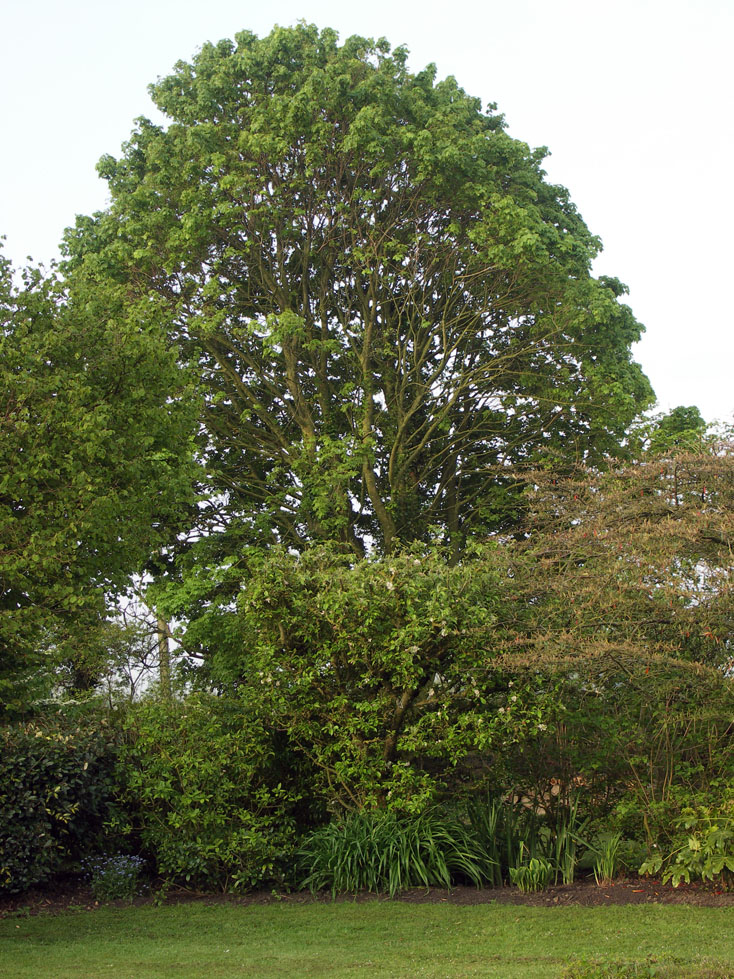
I fund myself looking to the trees around me for the tell tale signs of spring.  The Ash and the Oak on our lane are full of incoming migrants, such as chiffchaffs and blackcaps, filling the air with their distinctive songs.   I suspect the Ash is coming into leaf first, which is unusual, and suggests the prospect of a wet summer, if the old rhyme is to be believed:

‘Oak before Ash: in for a splash.  Ash before Oak: in for a soak.’

We had scaffolding on the house last week to enable some work on the roof. Standing next to the chimney piece, I realised just how tall the oak is.  A wet summer, or slightly leaky roof, would be the least of our problems if any sizeable part of this tree fell our way. 

But it is a feature of our lives just as other trees are. The Amelanchier, which we transplanted to the Spursy border a few years ago, has been in delicate blossom these past couple of weeks.  It reminds me of the Old Place, as my mother particularly valued it.  In contrast, I have never been a big fan of a Magnolia: the blossom is too blousy for my taste and, when fallen, it litters the place like discarded fish and chip wrappers.  The Amelanchier is far more delicate and refined. 

The Whitebeam that we placed in the back garden also reminds me of the Old Place.  My father bought a White beam soon after my mother died.  At this time of year, the soft silvery green buds anticipate the bright green leaves about to burst forth and delicate white flowers. It almost shimmers in the spring sunshine.

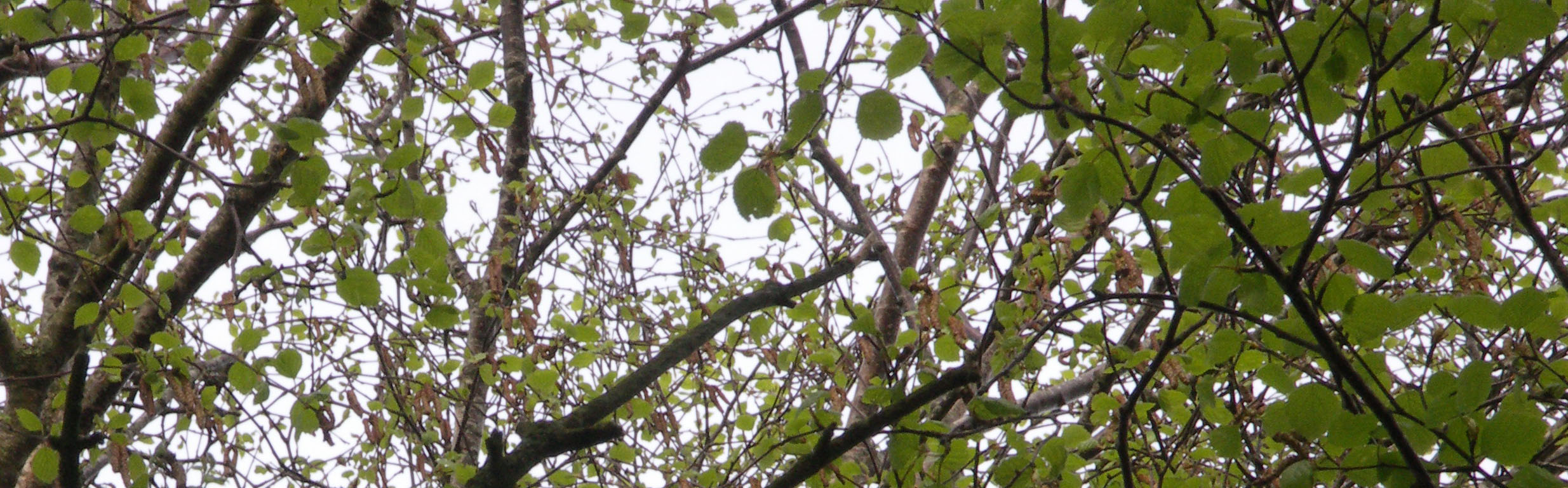
Elsewhere in the Spursy border, the three silver Birches are a major feature.  They are currently covered in catkins, which contrast pleasingly with the shiny bark.  They remind me of childhood trips to my grandmother on Ashdown Forest in Sussex. 

I think we are drawn to trees by their longevity. Most of them will be here long after we have passed. I often take pictures of them and none is more photographed and studied by us (and others) than the Tulip Tree (Liriodendron Tulipifera) down the road on Crawford Lane.  Commonly known as Josh’s Tree, it was planted in his memory by members of our village book group.  It is positioned on one of the main thoroughfares for dog walkers and has plenty of space to grow to its ultimate height of more than twenty metres.

A group of us dug it in during lockdown in a comical example of failed social distancing, which ended with the passing of an iPhone from unwashed hand to unwashed hand before one of us worked out how to take a selfie. I am pleased to report that we all survived the experience – particularly the tree.

Hardly a month or even a week goes by without me taking a photograph of it and thinking of my boy.  The tree will not actually flower for at least another ten or fifteen years, but just the shape and colour of the emergent leaves in the spring are a joy to behold, like small candles on the tree’s elegant arms.

Like the Oak and the Ash, it bears witness to our lives and, in a small way, the Tulip Tree will retain memories of our boy.

Spud You Like

Someone Told me to wash my silver birch...
Someone suggested cleaning my silver birch…

The February half term break feels like a significant moment in the horticultural year.  Mrs B is fed up with the cold weather, but finally it seems the days are lengthening, and March is nearly upon us, which, nominally at least, is the start of spring.  The growing season is imminent, but now I start waking in the night worrying that it is too late to sow annuals and veg seeds.

Last month Mrs B and I braved the winter chill to make the annual Potato Day pilgrimage to Caryford Hall, joining the line of fellow pilgrims earnestly shuffling past the colour-coded plastic tubs of first and second earlies or main crop chitters.  Unusually, I went with little planning or forethought on what I wanted, or perhaps it signifies how I kinda know what I want these days, without having to overthink it.  No plan was probably wise, as many of the spuds I would have grown in the past were not available, not even anything Arran based, so I randomly selected Jazzy, Pentland Javelin, and Caledonian Pearl.  All of them are earlies, as these days I tend to agree with Mrs B’s view that main crop do not justify their space in the raised beds. 

As we stood in line, I heard rumblings of discontent among the Potato Day punters. 

“They’ve got no International Kidney and no Pink Fir Apple”, muttered one middle aged lady. 

“Hmm.  It’s a pretty crap year” was her husband’s considered reply, which I thought was little harsh, as the Pennard Plants staff always offered a couple of alternatives, but that just led to more earnest debates on their relative merits.

“What do you think love, Marvel, or Sunset?”

Apart from potatoes, I bought some chilli seeds and aubergine seeds, as they need an early start, and I am pleased to say they are already germinating.  It is always exciting to see the first seedlings poking through.  I never tire of this horticultural ‘miracle of birth’ which spurs me on to sow lots of annual flowers.  The flowers seeds are germinating in the greenhouse, but I started the chillis and aubergines on the heated floor of the bathroom, which probably helped them, but created an element of jeopardy and mild peril for any nighttime trip to the toilet. 

Just another reason why Mrs B cannot wait for the warmer weather arrive.

One of our Own

It does not feel like only a few weeks since we were planting three silver birches in the new front border.  While a lot has happened in the world, for me the main events have revolved around staying at home and maintaining social isolation, which are coincidentally two of the key requirements to getting your garden looking good. 

I started my lockdown exercise regime by giving my back and shoulders a good workout, digging the tangled roots of shrubs and ash saplings from the front border.  It was the only way I was going to get the ground ready for planting, after the chances of getting a stump grinder slumped from minimal to zero. 

After four days of digging and hacking the job was done.  It took four days, but I did not work solidly all that time.  There were regular breaks for light comic banter from passers-who kept informing me “that looks like hard work”.  No shit Sherlock.  Whether they thought it really was hard work or whether they were commenting on my bedraggled, sweat-stained appearance giving the impression of hard-work, is a moot point.  But I responded with some amusing quip which rapidly turned to irony and then sarcasm as the tide of village humanity rippled its way past us on its daily release from quarantine, with no one able to resist the urge to state the bleeding obvious.

Staying within the confines of my property, though, I have managed to plant up the border, which I am creating as a memorial to Our Boy.  As a reference to Josh’s favoured football team I am designing it in the colours of Spurs – the team Josh was saddled with supporting as a baby when his uncle Richard inundated him with all the kit when he was barely a week old.  So the planting will be mostly white and blue, although there might be some lilac in there – as a nod to the away strips of 99 and 03 (and this season’s training top). 
“Design” is a word I normally hesitate to use in my gardening.  Mostly I bumble around and throw stuff into raised beds and borders on a whim, but this was going to take some planning.  Your average TV horticulturalist makes it look so damn easy, and when you take a look at the design sheets from Piet Oudolf for the garden at the Hauser and Wirth Gallery up the road, they are like works of art themselves.  But I have to start somewhere, so after browsing books on the subject and surfing the internet for “tall hardy perennials” I came up with the semblance of a ‘Spursy’ plan. 

Making up my squad of plants was not easy.  Like any good manager, I had cleared out a lot of the dead wood that I discovered when I moved in and started the re-building from the ground up.   Continuing the Spurs theme, I knew I would not be able to afford any top performers, already at the peak of their cycle, so I shopped around for a few bargains.  Which I duly found.  One source of quality plants was over in NI, at Ballyrobert Gardens who supplied a number of decent looking plants.  It feels very right that there is a Northern Ireland connection in Josh’s garden.  I have no doubt he guided me that way.  Here’s to you, Anya – not to mention Josh’s former colleagues at Hope Academy.
So, what plants are in the Tottenham terrain, you ask?  Well, we have a number of delphiniums which grow tall  and elegant but have a habit of falling over.  Those who remember Jurgen Klinsman’s days at White Hart Lane will agree this is apt.  While I would hope that all of my bought-in plants will be successful, having done my research on them, looking up their statistics on the RHS website and even taken time to view them at other gardens, I doubt that all will deliver what they promise. 

In addition to the plants I bought, I have a number of home-grown candidates that I am growing from seed – my academy players, if you like.  I have high hopes that the Echinacea White Swan seedlings might prove to be my Harry Kanes, though only time will tell.  But I live in hope: one cannot help feeling proud when it is one of your own that performs so well up front. 

At the moment, like the current Tottenham team, the border looks dull and lifeless, lacking spark or imagination.  But I am hopeful that, in time, it will be more “Poch” than “Jose” in style.  I imagine that some of the combinations of planting will work well together with good cohesion and synchronicity, while at other times and in other parts, it will be shambolic.  And while I expect it will do well for much of the summer, it will no doubt fade by the end of the season. 

To be truly Spurs-like I guess the border should be easy on the eye and unlikely to win any silverware.  But don’t judge me on this season alone.  This gardening game is a marathon, not a sprint.  We take each plant as it comes.  We do not look too far ahead but we will give it one hundred and ten per cent. 

But I would not want to be judged on just one season.  The pundits should only judge me after two years, by which time, perhaps, Josh’s Border – the “Spursy Bed” – might have clinched the Village Champions League title for best in the parish.

It will have been worth all that “hard work”.


Mayflower

Silver birch – memories of half term trips to grandmothers in Sussex and Surrey

I took the dog for a walk this morning and was pleased to see the Mayflower coming into bloom. The hawthorn blossoming always prompts a moment of nostalgia for me as I remember travelling home from University on the train and noticing – seemingly for the frist time – the heavy white drifts of flowers against the rich green billowing hawthorn trees and hedgerows. It was, of course, sunny and warm then and I was looking forward to getting back to the country from the big city and getting some home cooking.

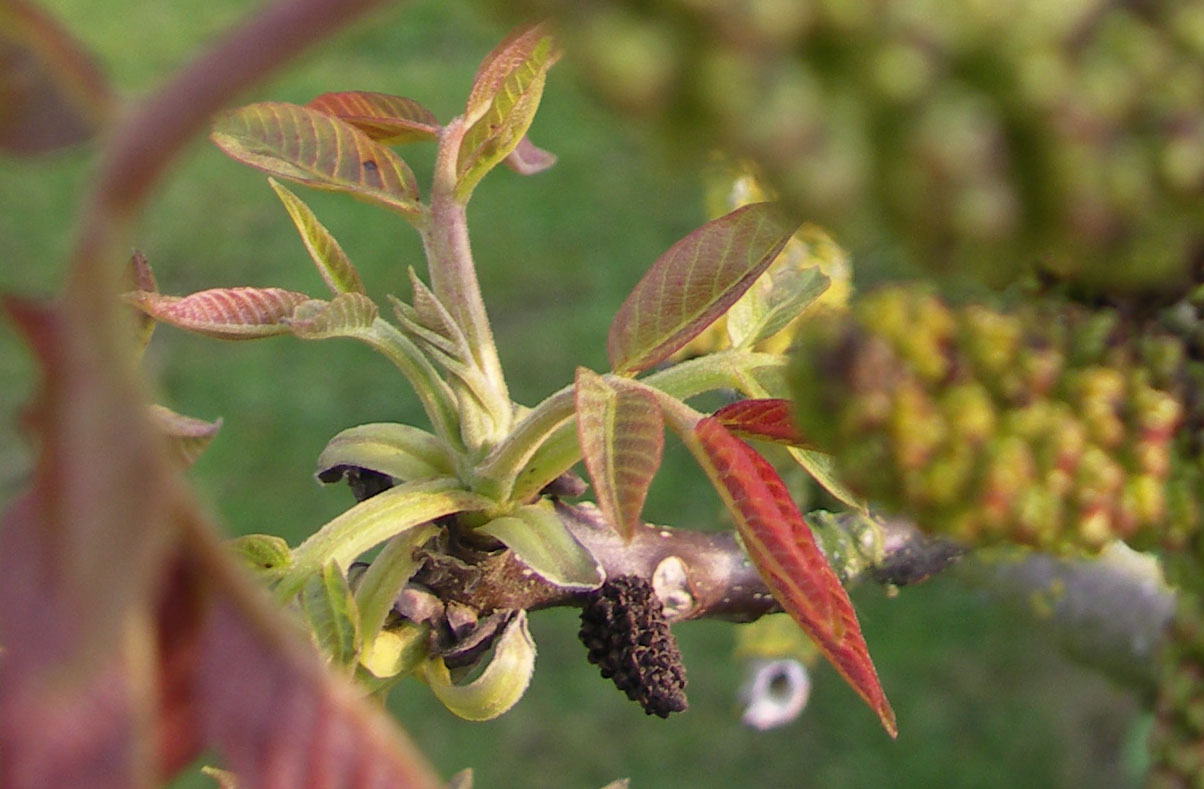
“Just now the walnut is in bloom”

It seems rather late in my life – late teens / early twenties – to have first noticed one of the obvious harbingers of spring, and I do wonder if my memory is rather selective in this sense. Could I really have been so unobservant as a youngster?  Had I not noticed such things or discussed them with my parents?

I am constantly staggered by the children I teach and even my own, at how  lacking in “common sense” they are and the basic knowledge that I fervently believe that we had as youngsters. Simple questions on geography, such as when I am asked if Europe is a country or when no one knows the capital of Spain. And when playing tennis, the number of kids who do not know how to score – at the age of 12?  At 12 I actually won the school tournament.  I was not a great tennis player – but I could keep the score alright.

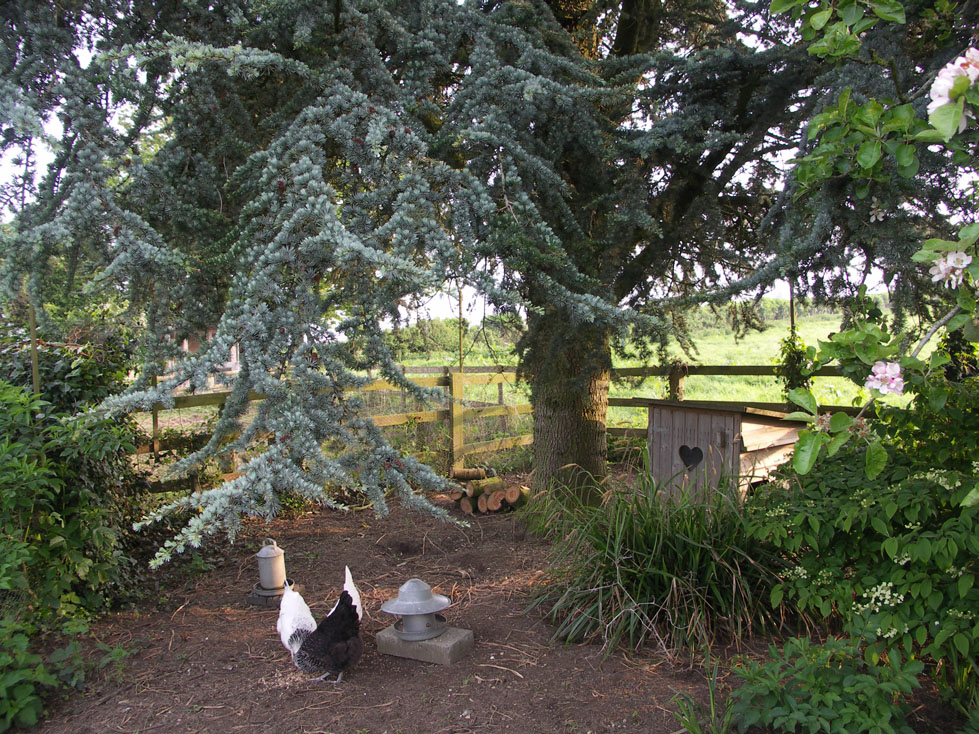
Happy hens with corn for breakfast under the Blue Cedar – planted circa1976

So perhaps my memory of being startled at the Mayflower at the age of 19 shows that I was as unobservant as the youth of today. But I do remember trying to learn the leaves of trees so that I could identify them. It was something that we did more of in those days – learning by rote.  I probably had an “eye-spy” book to encourage me, but around our way on the pasture lands of Somerset the main trees which delineated fields and hedgerows were Elms. These to me were not like the exotic Maples which are beautiful and sensitive in the summer and dazzle with their autumn colours, or Plain trees, their mottled bark creating impressionistic paintings of the dappled sunlight in French town squares.  Nor did Elms get anywhere near the blowsy generosity of the Horse Chestnuts with their flash flowers and bountiful autumnal booty which spawned so many playground conker contests and cracked knuckles.

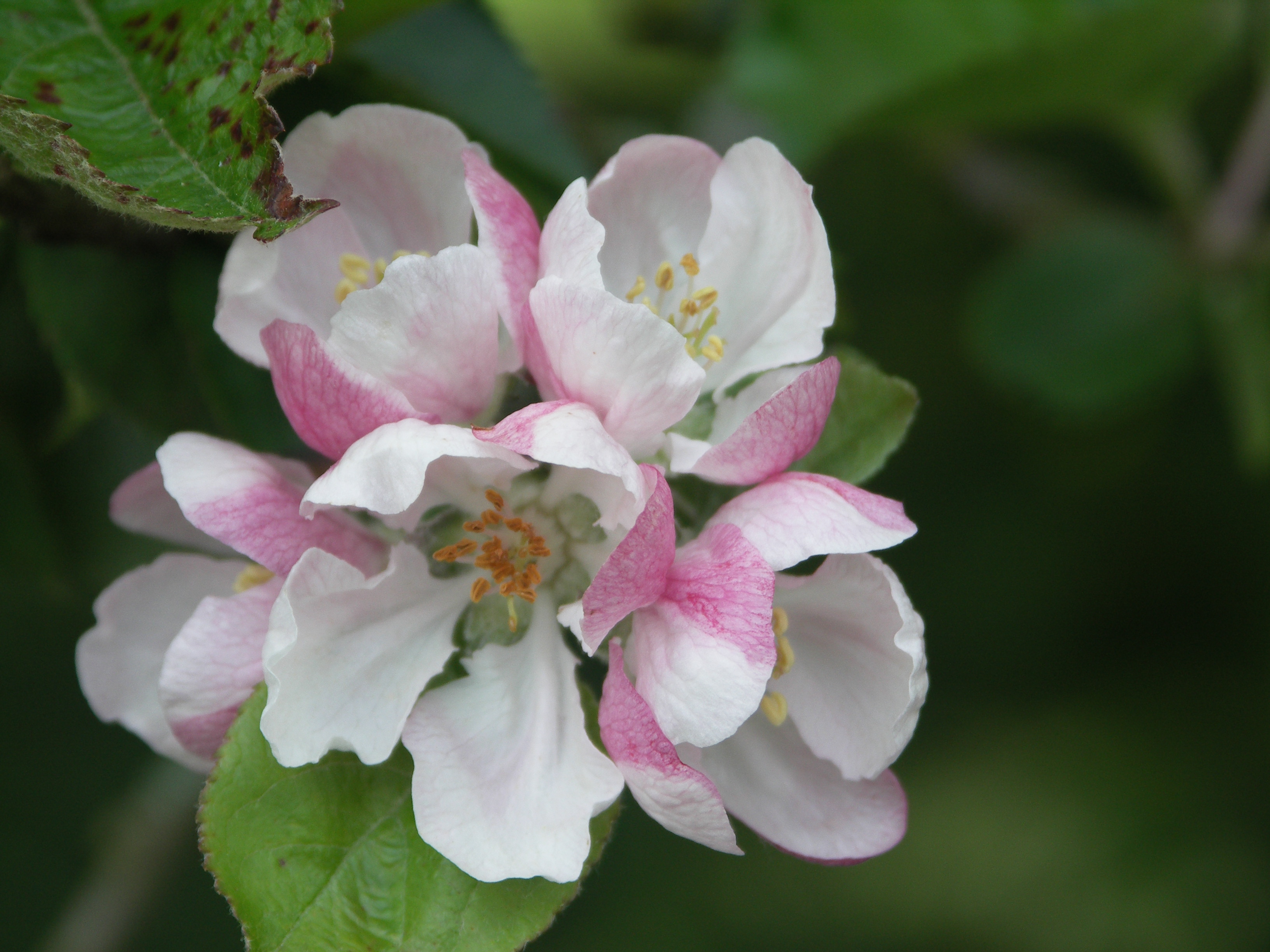
Apple blossom

No, the Elm was worthy but dull.  Good for climbing, if not too mature, but they were hulking presences in the fields.  Leaves that were small and rough, with stubbly hair like the face of a whiskered old lady.  The bark was just as you would expect bark to be on a tree, nothing more nothing less, and in the autumn the leaves turned an unspectactular yellow then dull brown before they fell to expose the heavy skeletal branches.  Growing to up to 45m in height they were just THERE as part of the back drop to life.  Nothing more.

But then they were gone.  In the space of 10 years Dutch Elm Disease  took away the physical context of  mychildhood.  It destroyed the countryside of my birth and created an air of melancholy as you travelled past row upon row of arboreal decay.  In its wake was left nothing but low scrubby hedges.  It seemed there were no other trees in the county: all was Elm, and all were gone.

That might not be true, of course, but as I walked Fudge today I saw a wide variety of trees around the fields and down the hill in the village.  There are horse chestnuts, oaks, ash, and more exotic numbers like cherries and the spiked outline of poplars.  Poplars are – like Plain trees – evocative to me of holidays in France, camping under them at Amboise, the constant sound of the breeze in them creating a cooling effect in your head so that you shivered even on the warmest days.  They to me were curious, ultimately pointless trees: too tall and thin to be deemed attractive in an expansive way, and useless in terms of fruit, flower or physical recreation.  Can’t climb ’em and can’t get anything useful from them.  They just stand there in line (they’re always in line – even down the road) creating a grandiose wind break.

So as I walk around the garden – the  garden my parents created from scratch – I am in quiet awe of their foresight and creativity with the number and variety of trees they have in one small patch of Somerset.  We have the original walnut trees, oak and ash, which were here when we arrived, but also the Blue Cedar, planted in the first year, and then various maples (snake bark), silver birch and apple, pear and crab apple.

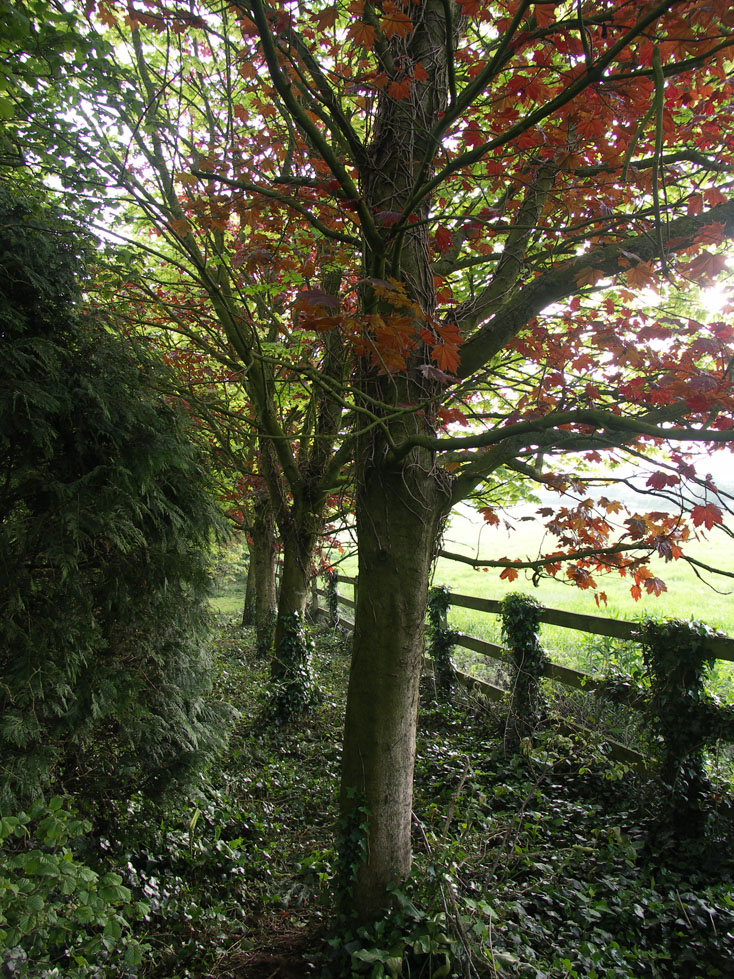
The copper maples I remember with particular relish.  There had been a selection of copper and ordinary which mum and I planted – as per instructions – at the end of the garden, alternating.  All afternoon digging holes for the large saplings.  When dad came home in the evening the first reaction was not thank and congratulate us on our work.  It was disappointment at not planting them in the right place.  Apparently they were a metre or two out of line.  I seem to recall he was simply handed a spade and told that he could move them himself if he wanted them in another position.  They remained there, thrived, and look good to this day.

It’s all about having a positive attitude again.  And I retain that when I look at the garden that my parents started and I am trying to maintain today.

Large Snake bark