The sun continues to shine unabated and the salad in the greenhouse grows an inch a day. So we are now into full-blown eat it or beat it mode. The different leaves are lovely to look at, and make a brilliant plateful of fresh salad. Combine that with one of Claire’s fine tartlets and you have a proper salad for a magnificent May Sunday. OK, the tomatoes are not our own (yet – the first trusses have set and the plants are coming on strong) but what a joy to behold.
We set up lunch on the patio table which sits outside the kitchen window in the drive. It is not the sort of table you move in a hurry as it was requisitioned from my brother’s bistro when they were changing their whole “theme”. It think it was designed to be too heavy to throw in a drunken brawl – which it certainly is. Anyway, the food looked and tasted good, with home-grown radishes (more planted already) and a decent bottle of co-op’s finest Fair Trade Carmeniere to wash it down. It felt like we were on holiday, which is pretty much how I try to approach life these days. Enjoy it like it is a holiday – even work! And we could have been in any part of continental Europe with sun baking the stone wall behind us.
Red Bombs Away…
Radishes are an interesting veg: I used to find that peppery taste too hot when I was younger, but either my tastes have changed or perhaps we don’t grow such violent radishes these days. But I love the look of them – the green leaves setting off the red and white body, which looks like a brightly coloured mini bomb. I hope it is the harbinger of good times to come with long days in the garden dining off the fruits of our labours under the Somerset sun…..eating outside house and home as if without a care in the world.
The weather has finally turned drier this past few days and my father can get to do what he really finds most satisfying: hoeing. He has always said this is his most rewarding job in the garden so I have had a few attempts over the last few weeks to see where the pleasure lies.
The ground definitely needs to be devoid of dampness to make sure that those pesky weeds are left high and dry. When conditions are conducive I can easily see why this is such a rewarding exercise. You are basically buffing up your garden without getting on your hands and knees to do it. But you do have to be careful: that hoe is a dangerous weapon in the wrong hands and in the wrong bed. At the week-end he decided to hoe some of the herbaceous borders, without realising that we had sowed some seeds in parts of them. And for myself, when hoeing around the vegetables I am in constant fear of taking off a healthy broad bean plant at ground level through my enthusiasm.
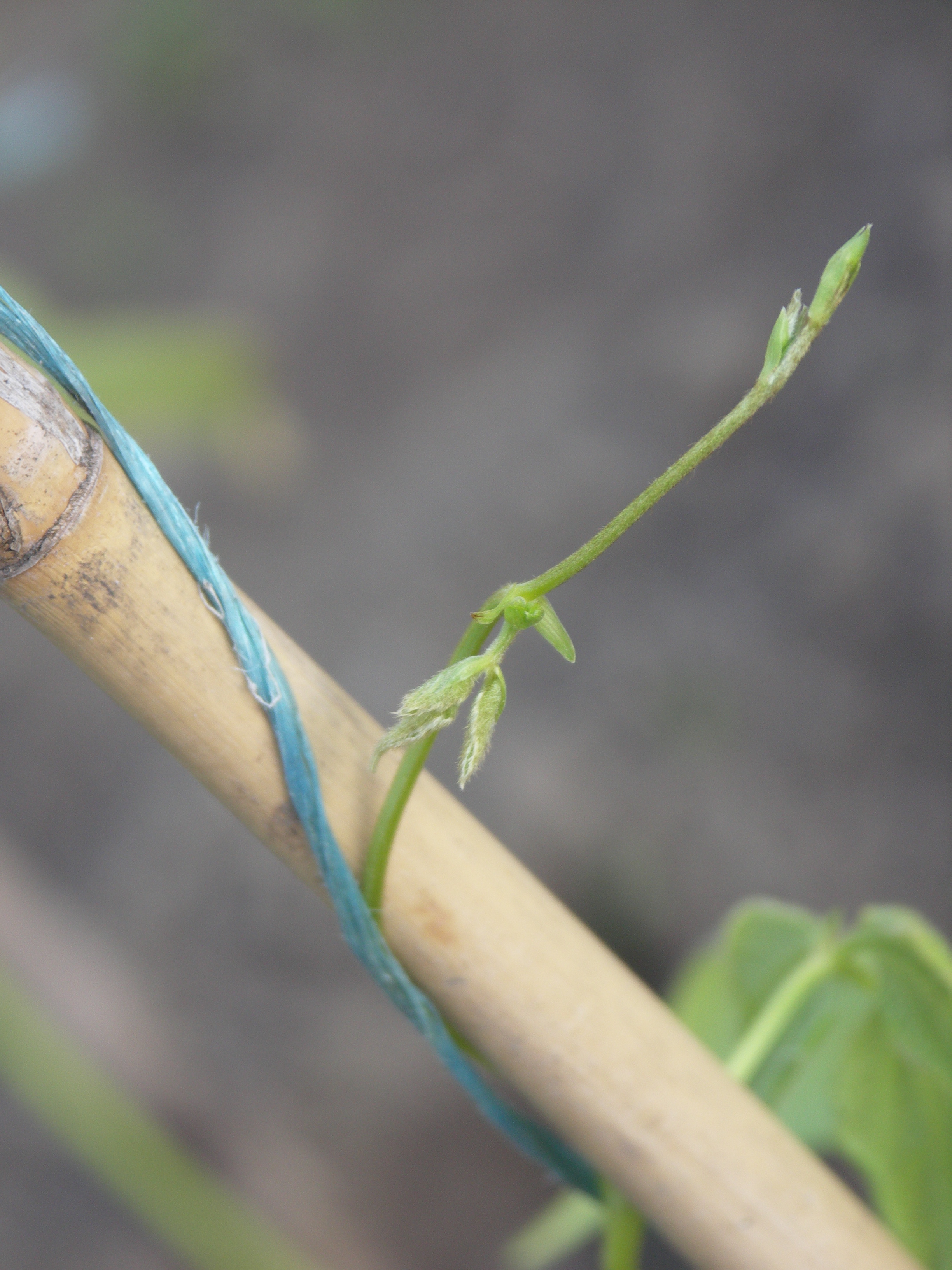
The beans are climbing, with a little help from blue string
Our good old traditional hoe is a fine and trusty looking tool. A blade securely attached to a solid pole by means of two sturdy metal arms with a crescent top. This is a hoe that has seen many a row of beans and borders and the pole is looking increasingly rotten while the blade is a dull rust colour. I had a go with it, and had some success, but then discovered my dad’s new hoe which is a light sabre compared to the dull claymore that is the old one. This one has a shining steel blade – or should I say blades, as it is secured only on side, while the other side can be used to deliver a lateral swipe. This is both useful and intimidating, as I now have the opportunity to destroy my bean crop with forward, backward AND sideways swipes.
I used it around my runner beans and broad beans. In recent years we have been picking veg while trying to dodge nettles and I do not want this to happen this year. My main weapon in this battle is the Vorpal Blade that is the old man’s hoe.
And what joy it brings. My borders and rows are looking dry and weed free with the soil nicely turned and friable, showing the plants at their best. That is something to bring a smile to one’s face. Perhaps even a little chesty chortle of joy.
Sunday I played golf first thing in the morning (7.35 start), was home in time for an excellent Azorieblue coffee, then went to school for a parents’ lunch in the boarding house before checking on the parents’ and girls’ tennis competition. But, with others running that, I was able to get “the best part of the day” (as my wife Claire would put it) and spend it on the veg patch.
Gardening is increasingly feeling like therapy for me. And there is no doubt in mind about its therapeutic benefits. Not only for me, but for my father as well, who I am sure is more likely to spend time of an evening walking around the grounds, gin in hand, taking in the sights and sounds of a well-tended and busy garden.
Therapy is an emotive issue in our family. A year ago Claire was diagnosed with a rare form of Non Hodgkin’s lymphoma – which for those who are not sure (and I would have been one of them a year ago) is basically cancer of the lymphatic system which may, or may not, be terminal. A year of chemotherapy has passed with Claire working her way through the pain, tiredness, hair loss and other grim side effects with determination and a large slice of black humour.
Along the way we discovered a blog called writtenoff.net, authored by a tough young woman called Ellie Jeffery who was suffering from secondary breast cancer. Her experiences and observations chimed with what we were going through with Claire and gave us hope and reassurance. Ellie’s prognosis was far worse than Claire’s and in the time that we have been reading the blog, Claire has gone into full remission and is making steady progress in her recovery from the last intense chemotherapy.
Sadly on Sunday night the latest entry was posted on Ellie’s blog. Written by her fiance, Tom, it broke the sad news that Ellie had died three days previously – finally succumbing to the ravages of the disease. It was a devastating piece of news which immediately brought Claire and I up short – thinking of what we had been going through in the past twelve months and how fortunate we have been so far.
It also took me back six years to the day that my mother died of pancreatic cancer and the massive sense of loss I felt when I walked into her hospital room after her death. It was more than emotional – there was an enormous spiritual absence. It is a feeling that has lived with me ever since, and I wonder if my commitment to maintaining the garden is in some way my delayed response to mum’s departure. Am I perhaps doing it for her. Gardening as a form of memorial.
There is no doubt that by gardening one is able to get in tune with seasons, and get a feeling of one’s place in the world. The death of a loved one – or simply the serious illness – focusses the mind and one can turn in on oneself, but it also makes you view the world in a sometimes more equable and balanced way.
It is too glib to say that Life Goes On. When a life ends it can leave an enormous gap in everyone else’s – but the memory lingers and can be kept strong through the deeds of those left behind. We are part of a broad and beautiful world which at the base level is growing and dying all the time. Planting, watering, harvesting are reminders of the natural order of things and definitely help me to deal with the ups and downs of existence. Such acts would be of little aid to the friends and family of Ellie Jeffery, but our thoughts are with them at this time and hopefully the overwhelming messages of support on her website will be of comfort to them as they come to terms with their loss.
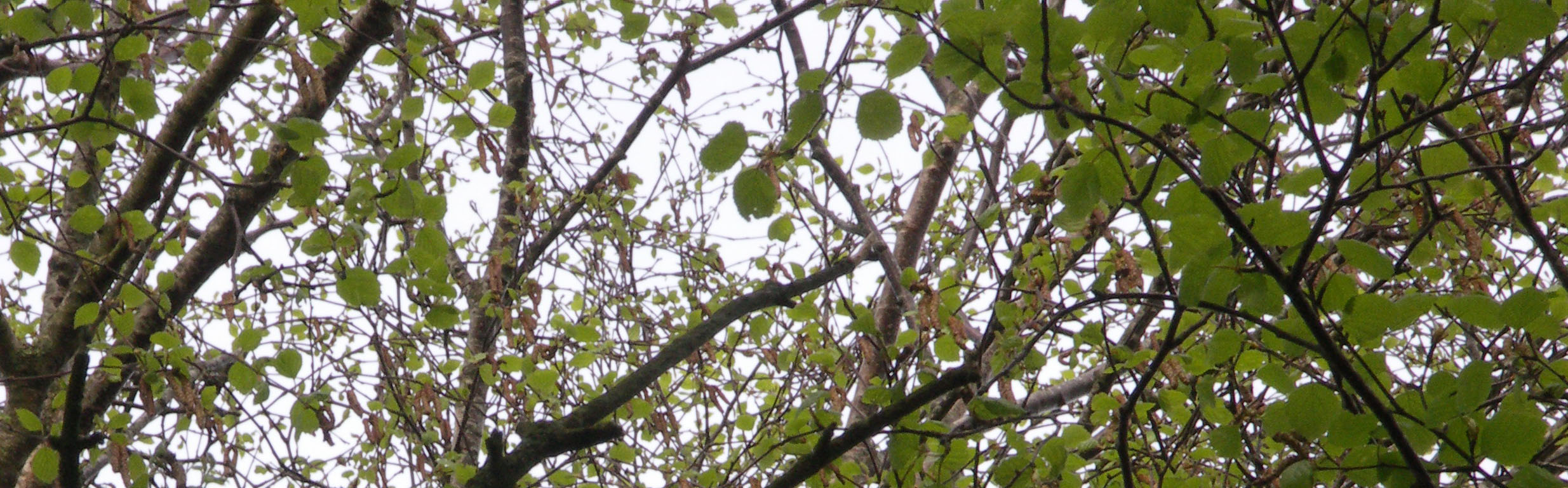
Silver birch – memories of half term trips to grandmothers in Sussex and Surrey
I took the dog for a walk this morning and was pleased to see the Mayflower coming into bloom. The hawthorn blossoming always prompts a moment of nostalgia for me as I remember travelling home from University on the train and noticing – seemingly for the frist time – the heavy white drifts of flowers against the rich green billowing hawthorn trees and hedgerows. It was, of course, sunny and warm then and I was looking forward to getting back to the country from the big city and getting some home cooking.
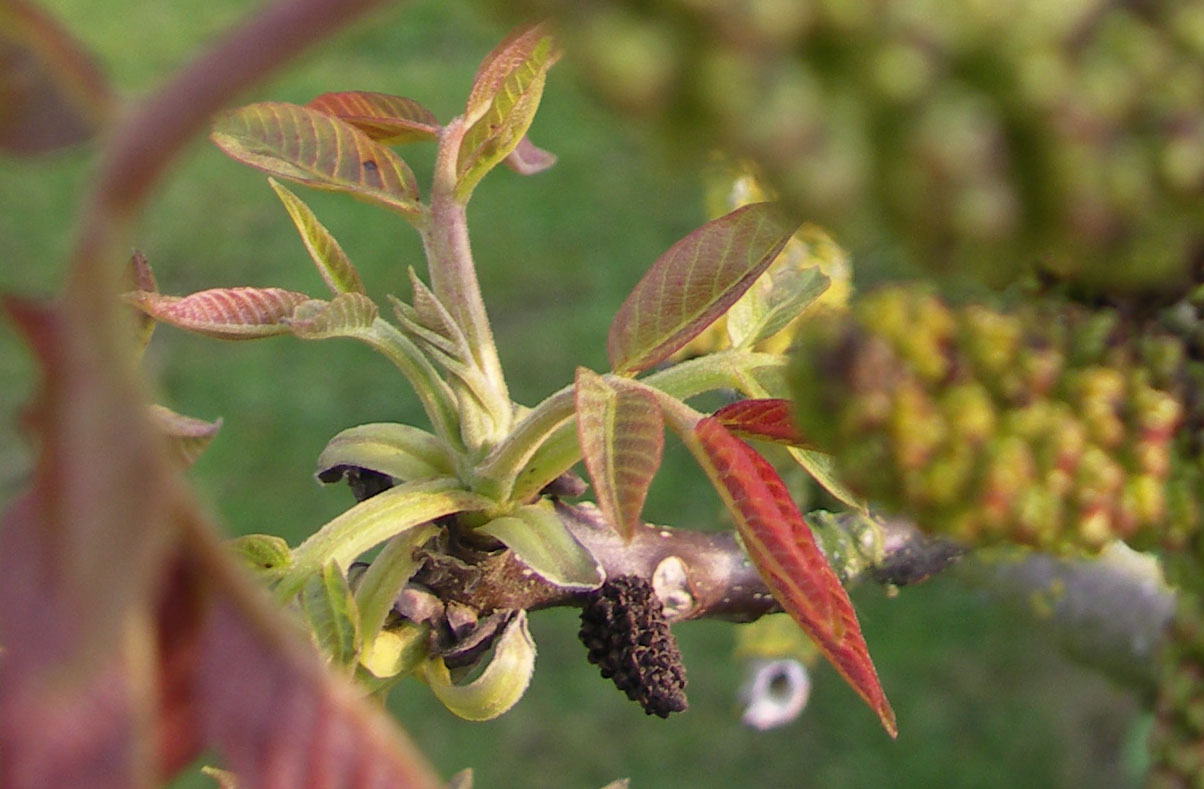
“Just now the walnut is in bloom”
It seems rather late in my life – late teens / early twenties – to have first noticed one of the obvious harbingers of spring, and I do wonder if my memory is rather selective in this sense. Could I really have been so unobservant as a youngster? Had I not noticed such things or discussed them with my parents?
I am constantly staggered by the children I teach and even my own, at how lacking in “common sense” they are and the basic knowledge that I fervently believe that we had as youngsters. Simple questions on geography, such as when I am asked if Europe is a country or when no one knows the capital of Spain. And when playing tennis, the number of kids who do not know how to score – at the age of 12? At 12 I actually won the school tournament. I was not a great tennis player – but I could keep the score alright.
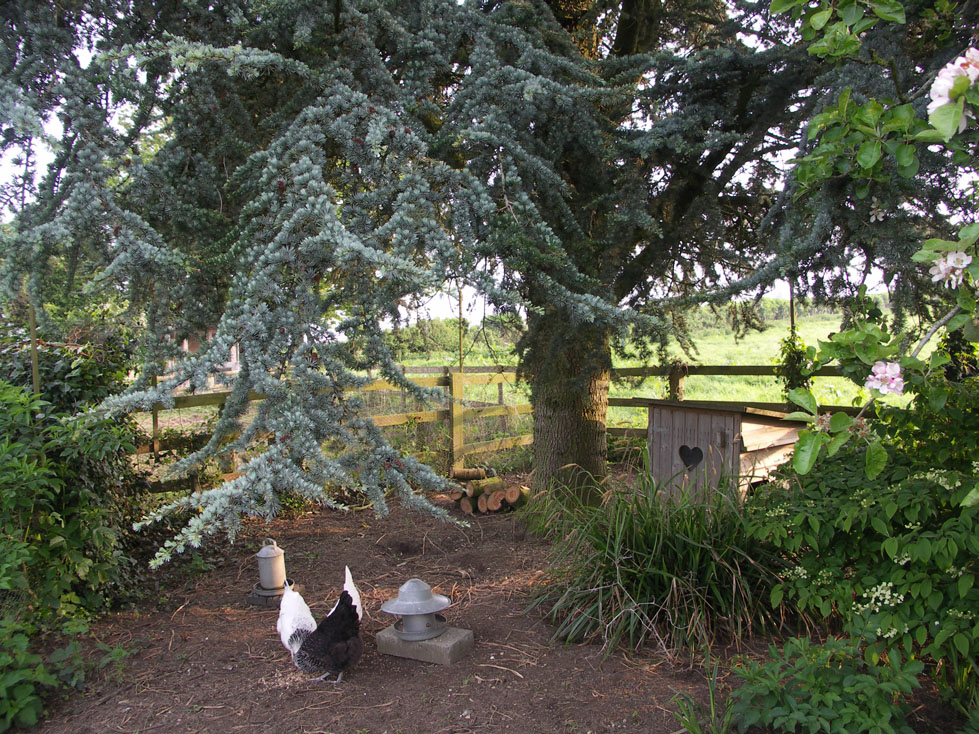
Happy hens with corn for breakfast under the Blue Cedar – planted circa1976
So perhaps my memory of being startled at the Mayflower at the age of 19 shows that I was as unobservant as the youth of today. But I do remember trying to learn the leaves of trees so that I could identify them. It was something that we did more of in those days – learning by rote. I probably had an “eye-spy” book to encourage me, but around our way on the pasture lands of Somerset the main trees which delineated fields and hedgerows were Elms. These to me were not like the exotic Maples which are beautiful and sensitive in the summer and dazzle with their autumn colours, or Plain trees, their mottled bark creating impressionistic paintings of the dappled sunlight in French town squares. Nor did Elms get anywhere near the blowsy generosity of the Horse Chestnuts with their flash flowers and bountiful autumnal booty which spawned so many playground conker contests and cracked knuckles.
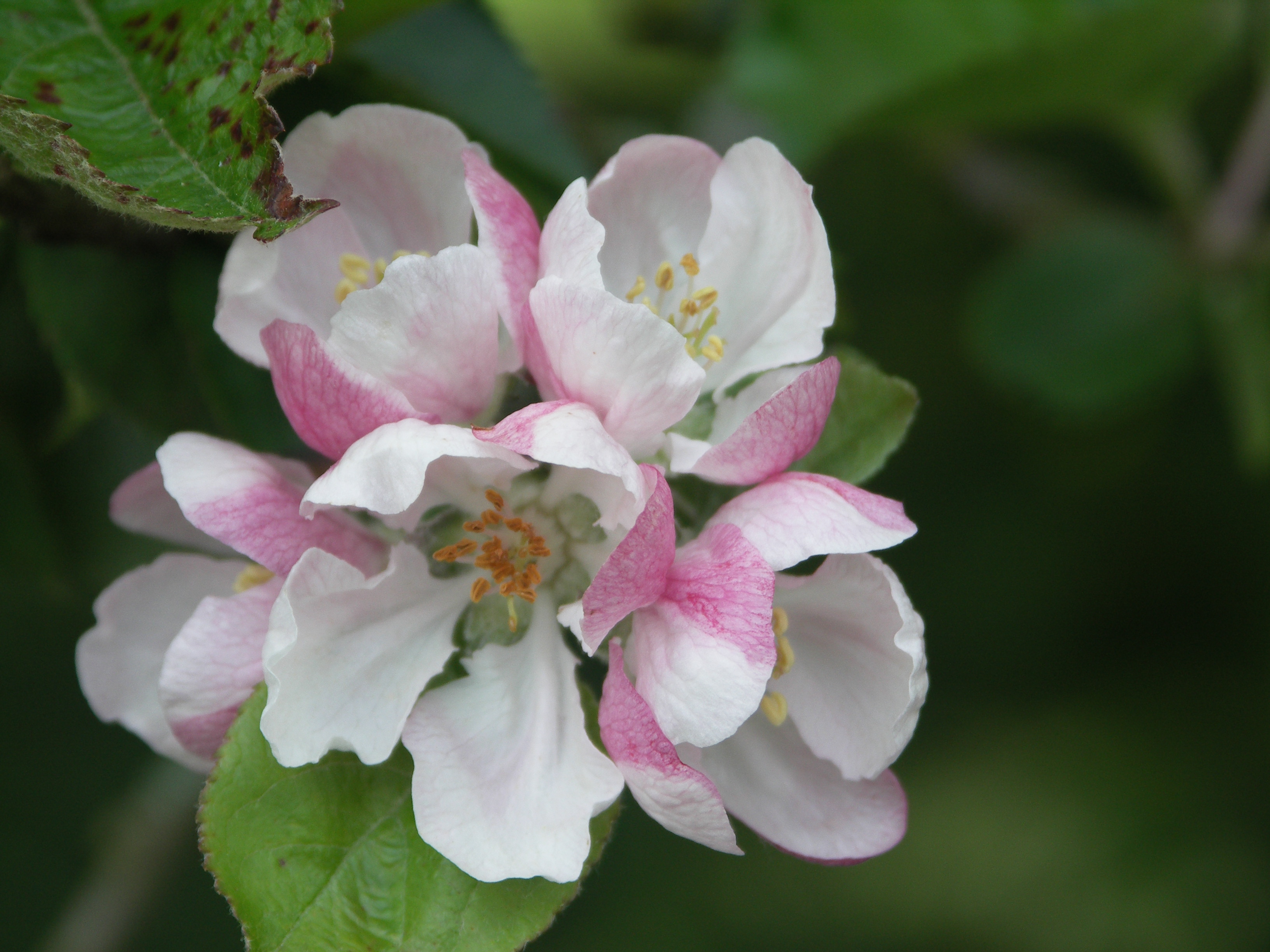
Apple blossom
No, the Elm was worthy but dull. Good for climbing, if not too mature, but they were hulking presences in the fields. Leaves that were small and rough, with stubbly hair like the face of a whiskered old lady. The bark was just as you would expect bark to be on a tree, nothing more nothing less, and in the autumn the leaves turned an unspectactular yellow then dull brown before they fell to expose the heavy skeletal branches. Growing to up to 45m in height they were just THERE as part of the back drop to life. Nothing more.
But then they were gone. In the space of 10 years Dutch Elm Disease took away the physical context of mychildhood. It destroyed the countryside of my birth and created an air of melancholy as you travelled past row upon row of arboreal decay. In its wake was left nothing but low scrubby hedges. It seemed there were no other trees in the county: all was Elm, and all were gone.
That might not be true, of course, but as I walked Fudge today I saw a wide variety of trees around the fields and down the hill in the village. There are horse chestnuts, oaks, ash, and more exotic numbers like cherries and the spiked outline of poplars. Poplars are – like Plain trees – evocative to me of holidays in France, camping under them at Amboise, the constant sound of the breeze in them creating a cooling effect in your head so that you shivered even on the warmest days. They to me were curious, ultimately pointless trees: too tall and thin to be deemed attractive in an expansive way, and useless in terms of fruit, flower or physical recreation. Can’t climb ’em and can’t get anything useful from them. They just stand there in line (they’re always in line – even down the road) creating a grandiose wind break.
So as I walk around the garden – the garden my parents created from scratch – I am in quiet awe of their foresight and creativity with the number and variety of trees they have in one small patch of Somerset. We have the original walnut trees, oak and ash, which were here when we arrived, but also the Blue Cedar, planted in the first year, and then various maples (snake bark), silver birch and apple, pear and crab apple.
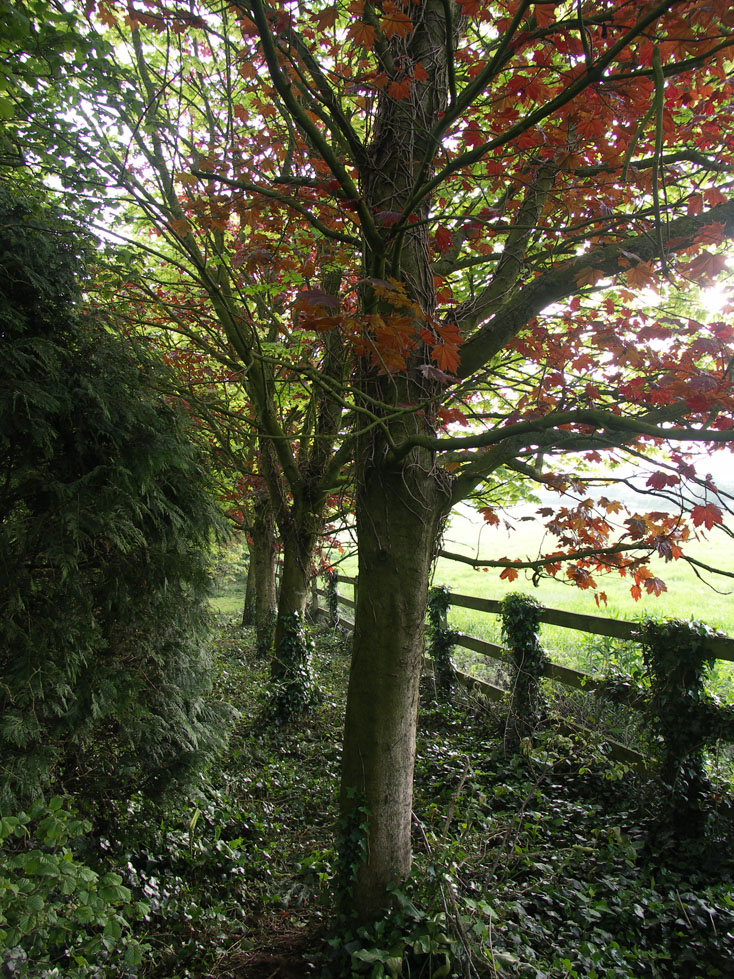
The copper maples I remember with particular relish. There had been a selection of copper and ordinary which mum and I planted – as per instructions – at the end of the garden, alternating. All afternoon digging holes for the large saplings. When dad came home in the evening the first reaction was not thank and congratulate us on our work. It was disappointment at not planting them in the right place. Apparently they were a metre or two out of line. I seem to recall he was simply handed a spade and told that he could move them himself if he wanted them in another position. They remained there, thrived, and look good to this day.
It’s all about having a positive attitude again. And I retain that when I look at the garden that my parents started and I am trying to maintain today.
Today I managed to take another leaf out of my father’s book, to follow in his footsteps, be the unwitting victim of the power of fate and to once more be filled with the horror (the horror) of the dread of heredity.
The final day of the Premier League football season proved to be possibly the most crazed and nail-biting that any one can remember, with twists and turns of fortune throughout the afternoon. I, as a classic Man U fan (never been to a home fixture etc etc – you know the sort) was offered the chance to watch the excitement on TV, but I instead opted for an afternoon in the garden with the radio to give me the pictures.
Sarpo Mira
I could not help noticing the similarity with 1966 when, on the day that Enlgand had a chance to lift the world cup, my father could not stand the tension of the moment and instead spent the afternoon digging in the allotment. I have never been able to understand how he missed the greatest moment in England’s footballing history. And yet, as I planted cosmos and nasturtiums this afternoon while Man City did their best to refuse to accept the title from united, the parallels were too close ignore.
In my defence, it was about the best day of the year so far, and the simple matter of being outside instead of in was overwhelmingly attractive. So an afternoon spent planting flowers – nasturtiums, cosmos, cornflowers and Nigella – into the borders to brighten them up later in the summer. And I will forever look upon the lavender beds next to the sundial with mixed emotions as it was there that I was weeding when City scored twice in the dying moments to clinch an amazing victory.
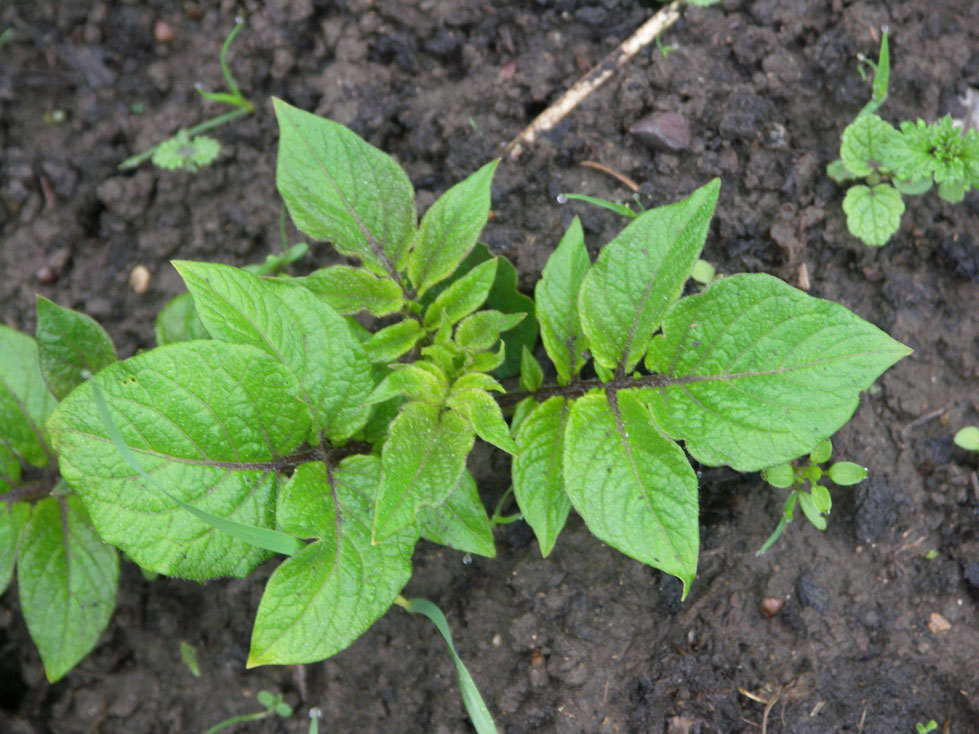
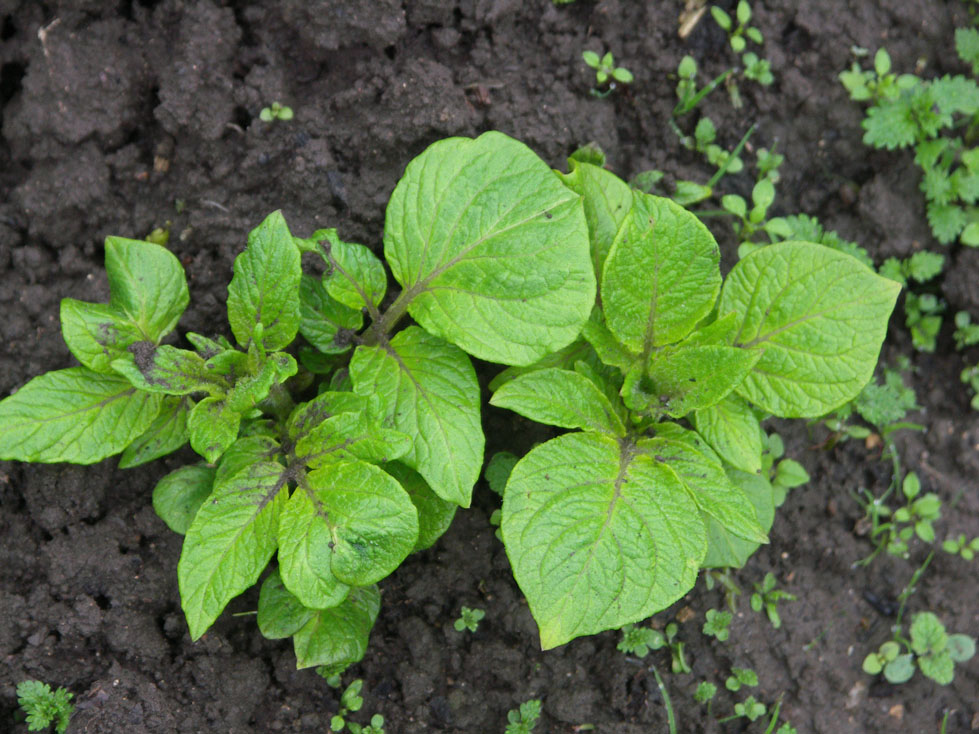
Elsewhere, the potatoes are really shooting up, with the parsley also actually arriving at the party, after weeks of sitting miserably in the wet cold soil. I am beginning to get some idea of the variations in germination for plants. All pretty basic stuff, but I did not realise how long the parsley – which has seeds like large bits of grit – would take to sprout compared with, say, the radishes next to it. But it has finally done so.
Belle De Fontenay
Meanwhile in the greenhouse, extra ruby chard I planted has just sprung up, compared with pin points of ruby in the beds, while the brussels and purple sprouting are jumping out of the soil in their seed trays. I might have to do something similar with the parsnips which I sowed, as per the packet instructions, one per 30 cms in rows outside, only to be solemnly informed by my “gardening conscience” (the old man) that parsnips have notoriously poor germination rates. So I am thinking that I might have to wait months only to discover that I have one parsnip to last me a year!
Never mind, I think I will plant some in
Arran Victory
seed trays, in newspaper cones (I am advised on Saturday night by Piers and Hazel), so I can transplant easily. Might do the YouTube video “how to grow parsnips in paper” or some such title. Or maybe I will just sit outside avoiding telly, watching the garden grow – and all those different potatoes.
At last we have a sunny day. After last weekend’s rain and the continuation this week, it was a relief to be able to get out in the sun on Saturday. Jim had been around the garden on the mower, having already strimmed the edges (MY edges!) so the place was looking tidy.
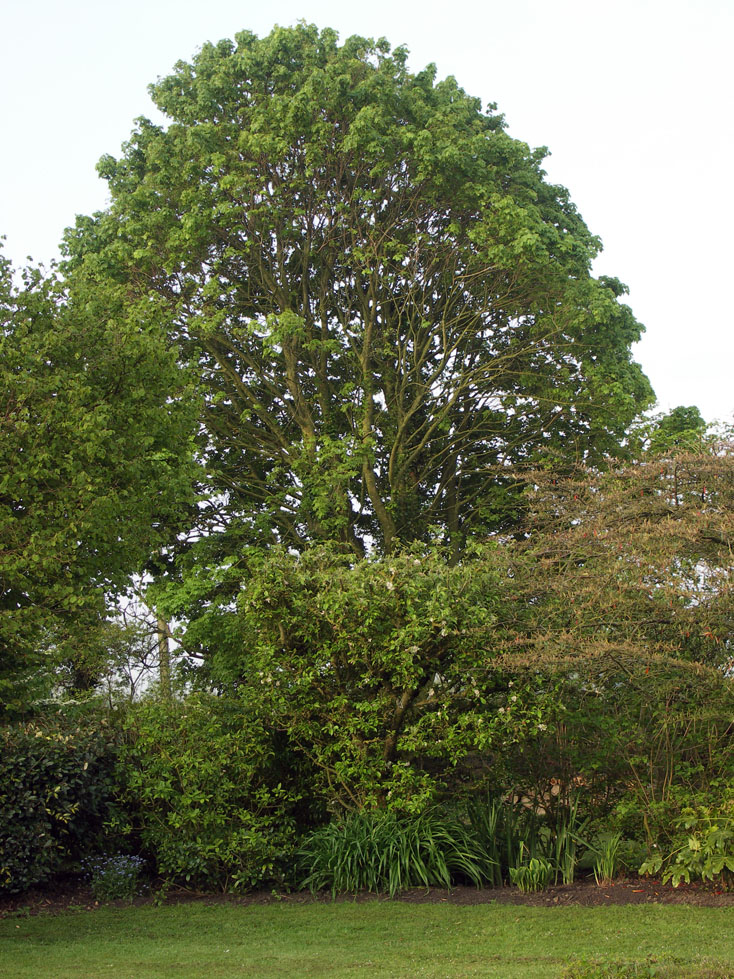
Oak before Ash..in for a Splash. That’s a joke with the rain we are having!
In the greenhouse the runners and french beans are all beginning to raise their heads like zombies in Thriller, the compost creaking and cracking as the beans push their heads up and start to unfurl. Overnight they continue and during the day you feel that you could almost see the growth with the naked eye. You just need a good book and a decent supply of coffee to keep you going.
As it happens, I have sourced both of those items this week-end. I am currently reading Kathleen Jamie’s second book “Sightlines” – a gem of a book which is part autobiography, part observation on nature and what it is to be a human in the Grand Scheme of Things. The book is a series of essays and her descriptions that range from Gannet colonies in the Shetlands or icebergs in a Norwegian fjord to remembrances of archaeological digs are both acute and thought-provoking. I highly recommended read which I inspires me to get outside and view my own rural surroundings with a fresh eye.
Smoother than a Tiger in a Tuxedo. Coffee on the beach
My source for good coffee originates with a cup of coffee we had at the Dorset Food Fair a couple of summers back. It came from a little stall selling Azorieblue coffee and tasted seriously good. I don’t profess to know a great deal about coffee, but I know what I like – and this hit the spot. I decided I would get some myself. It only took two years, but finally – this past month – I ordered some beans from Azorieblue. Unfortunately there was a mix up somewhere which meant I got ground instead of beans for my new Krupps grinder. It was probably my fault, but when I emailed them (I say them…I reckon there are only a couple of them in the company) they invited me to visit them at the Lyme Fossil Festival where they would be supplying coffee to the thirsty palaeontologists.
We duly turned up yesterday – me with my bags of ground Brazilian espresso. The place was heaving – it was, after all, the only sunny day of the bank holiday weekend – but we found them in a tent alongside the fossil sellers. Adriano seemed genuinely pleased to see me and enthusiastically talked me through his coffee and why it tastes so good. He poured me a strong latte that knocked my socks off for taste, not to mention caffeine content. We stood and chatted while the caffeine buzz kicked in before we left with free bags of beans and other Azorieblue goodies.
The Oak tree – with stakes stored for use soon.
His promotional material claims his coffee is smoother than a tiger in a tuxedo or more luxurious than a Kashmir codpiece. Well, Adriano shows more passion than an Italian Valentine’s Party when it comes to coffee and I recommend it wholeheartedly.
So a good afternoon in Lyme Regis was followed by more labour in the garden as I continue to reclaim the central border. More grappling with ground ivy and nettles and we are pretty much there. I feel that I deserve a break – perhaps a cup of coffee and good book. Reading in the evening always sends me to sleep, but a good cup of Brazilian will keep me awake.