Grow, Grow, Grow

I was as excited as any other birdwatcher when I read about the Bearded Vulture that has been spotted in the Peak District and Yorkshire. Also known as a Lammergeier, this is only the second time such a bird has been spotted in Britain this century. Which makes it almost as rare as a Cabinet Minister telling the truth. Or a Special Advisor admitting an error. It is thought that this is a juvenile Lammergeier that has simply got a bit blown off course – admittedly by a few thousand miles. The bird obviously thinks that we still live in a Europe of open borders and no distrust of foreign immigrants. Oh, the naivety of youth.

When I was a naive youth, the Lammergeier was top of my must-see list of birds on the occasions when our family French camping holidays took us to the Pyrenees. We saw lots of other eagles and vultures, but never a Lammergeier. It would be amazing to spot one, but I will not be making the trip to Yorkshire to try and see it. Even without the lockdown restrictions having been lifted (for those of us who abided by them in the first place) I will not be leaving the garden for any of length of time at the moment. Because this is the time of the year when the hard graft finally pays off. It is the time of the year when my parents would say that there was no way they could go on holiday, because the peas will need picking, then the beans, the courgettes and all the other veg that they grew on an industrial scale.

And I now understand their sentiments. The scale of my veg and flower patch is nothing to compare with theirs. Mrs B and I are not interested in the long hours of blanching and bagging veg which my parents engaged in, to enable them to freeze enough greens to see them through the winter. But we currently have more peas, sugar snaps, courgettes, kale, carrots and runner beans and french beans than we could shake a big Tory Lie at. Not to mention salad leaves, cucumbers and, this week, the first tomatoes in the greenhouse.

The sighting of a rare vulture in Britain is a relief from the other depressing news (although it also brought into focus the illegal persecution of birds of prey such as the hen harrier on nearby grouse moors). Being in the garden has also provided solace for me and Mrs B. The flowers are looking particularly fine at the moment and Josh’s Spursy Border is performing far better than I had any right to expect in its first season.

All this has happened not because we made any spurious promises or deadlines, or pretended we had seeds in stock when, in fact we had not. We did not double count plants or make up random straplines like “We will get digging done” or “pick, pick, pick”. No: we just got on with it.

And now, like the Lammergeier in Yorkshire, who must have been a bit tired after its long journey over half of Europe, we will take stock and enjoy the fruits of our labour.

Stereotyping

As I dropped my daily aspirin into the glass of water, I asked Mrs B what it reminded her of.  Quick as a flash she said “Plink, plink, fizz: Alka Seltzer” and we laughed.  It was exactly what I was thinking too.

“And that is why they want to ban adverts that portray gender stereotyping” I replied.  If one harmless advert is still referenced by us forty years on adn influences our way of thinking, what effect is the apparent stereotyping of male and female roles in adverts going to have on the youth of today?  Not much, I suspect, as I am not too sure the sight of men getting their thrills being active while the woman enjoys peace and quiet with a book and a sleeping baby is going to have too deliterious effect.  Should we be concerned that some advertisers are suggesting that (white, middle class) women are good at looking after children and (white, middle class) men do not read enough?

At a time when we have politicians on a daily basis blithely reinforcing national and racial stereoptying without any noticeable penalty, I do not see that a few adverts making jokes at the expense of absent-minded fathers is that big a deal by comparison.  But hey we have to start somewhere I guess.

In the Midlife Garden we have no such worries of stereotypical activities, as Mrs B and I happily allow each other to take on non-gender defined roles.  Mrs B enjoys nothing more than a bit of slashing and hacking as she has chopped overgrowing ivy and Forsythia, keeping hedgerows in their place.  I take satisfaction from quieter activites such as sowing seeds, thinning and planting as I have started to attempt successive harvests of salad leaves and beans, as well as sowing some hardy annuals for the cut flower patch planned for the spring.

“Being a bit of a Marjory” is how Mrs B puts it, something that originates from the time I was pricking out (fnarr, fnarr) in the greenhouse while she was being active and energetic hurling stakes in the veg patch.  All very amusing, but could there perhaps be a hint of gender stereotyping in the pejorative use of the name “Marjory”?  I think she needs to be picked up on that…

Too early or too hot?

Another hot, dry start to the summer, another discussion about climate change.  At the end of term I sat through several showings of documentaries on climate change which alarmed and depressed me in equal measure.  Alarming because the stats suggest we are going to global hell in a fossil-fuelled hand cart.  Depressing to hear climate change deniers like Nigel Lawson and American news channels, led from the front by The Donald, for whom  denying climate change suits their personal goals.  Nor was my dark mood alleviated by the attitude of the year 9 geographers who were more interested in trying to wind me up than discovering how to save the planet.

However, back at home Mrs B is leading our efforts to preserve Planet Earth for our descendants as we use our Bags for Life, watch our home-produced solar power being stored in our battery and even revert to soap-on-a-rope to reduce our consumption of single use plastics.  We can save the plantet….

Elsewhere, in the garden I have to cope with the change in crop behaviours as veg and flowers adapt (or not) to the latest hot dry spell.  And this summer – like last year – it feels as if a lot of the vegetables are out of kilter.  In the raised beds, only the early croppers did well such as garlic, onions, shallots and new potatoes, which thrived in the early summer warmth.

In contrast, the beans had all gone over by the time we returned from hols at the end of July, leaving us with knobbly Runners and Frenchies rather than the sweet tender pods we would normally harvest.  Perhaps I made an error in trying to reduce the wastage of previous years by planting just a wigwam or two, instead of serried ranks of them.  So when the purple beans got half way up the poles before stopping in their tracks, flowering and dying, I had no back up.

I have belatedly effected second plantings of lettuce and beans, but they have had a hard time of it with the slugs (and probably the dry weather).   Today I planted them out, giving them the same choices that Mrs B always tells me they have:  to live or to die.  I suspect the latter will be the inevitable path for them.

Of course, it might not be climate change or global warming that is the problem at all.  It might just be that I have simply not adhered to my father’s age old advice.  He always told me that I planted my runner beans too early.  So maybe it was just another case of “too early for runner beans”.

Mid-Term Reports

img_20180808_084533092Deadline for reports was about three days ago but as I no longer have someone to swear at me if I am perceived to be late or include too many ‘gramatical errors’ (sic),  I have stuck to my usual report writing schedule, by submitting mine in my own time.

No More Bull Shit – herewith the mid-term garden reports.

Beans, Broad

A good start to the term, and working hard in the early weeks, they seemed to get lazy and did not capitalise on the good work early on.  The results were, frankly, disappointing with grade E across the board (or is it 1 now?)

Beans, Runner and Green

Runners and Greens have had a good term.  It is clear that MFL and PE are their strong subjects, and they have easily adapted to the European-style heat and the need to compete in hot weather.  They need to keep on, though as there have been signs of letting up in recent weeks and some of their work has started to look a little shoddy.

Courgettes

A truly memorable term for the Courgies, with early efforts, leading to excellent results to the point of being embarrassingly good.  I have rarely seen such excellent results with undoubtedly so much more to come.  Well done – a super effort.

Peas

Another one who looked to have settled into the new year, but seemed to become distracted and unruly, never really progressing.  It appears that there was some disruption with bullying by sparrows which might have been an issue.  The second intake of peas seemed to have settled this problems with Special Needs fleece being used to provide protection, but unfortunately the late start for these and lack of nursery education has meant lower than expected grades.

Potatoes:  Swift, Duke of York, King Edward, Sarpo Mira

Spuds have had a variable term.  Swift did do well to begin with, but could have done better with a more conducive setting as a lack of resources seemed to hamper development.  The Duke of Yorks have struggled too, with their results showing a wide fluctuation from 9 to 1 in grading.  It is too early to report on King Edward or Sarpo Mira.

Salad

In general salad has a had good term, although the dry weather has affected their ability to concentrate for too long.  Too often they have complained that slugs and other bugs are distracting them and hampering their progress, but when they have established a good working routine the work produced has been of a fair quality.  There is no doubt that they could do better if they tried, particularly the chard and rocket which have had a particularly disappointing term.

Tomatoes

What an excellent set of results.  Tomatoes have been a revelation this term.  They have been excellent individually and have also shown the ability to excel in small group work as sweet millions have produced some very impressive early results with the Jersey Devils promising to submit course work of very high standard.  Mrs B, the head of tomato assessment and monitoring has been particularly impressed with this years tomato cohort and they will undoubtedly be contenders for the the “most improved” prize on speech day.

Basil

Well done to basil on yet another excellent year.  Italian has been a strength of this year’s intake – “molto bene!”

Squash: Crown Prince and Blue Kuri Kabocha

Squash have been very active this term, bordering on the unruly, although they have seemed to settle into the new premises.  The work produced has been extensive, though it remains to be seen how focussed and concentrated this has been and how this is actually going to translate into favourable results: i.e. good sized ripe squashes.

Kohl Rabi

Kohl Rabi were late starters this term with a lack of nursery time leaving them behind other veg in the early years group.  Only time will tell if they are able to make this up but they are trying their best, with an A1 for effort, despite the distractions of cabbage white butterflies.

Kavolo Nero

Early work was hampered by the bullying sparrows while their later efforts have seen no homework handed in for weeks due to the destructive influence of cabbage white butterflies.  Between times there have been some excellent pieces of work and when the butterflies have gone there might perhaps be more good work to come.

Mixed Ability Class: Carrots, beetroot and chard

This has been the best ever intake of carrots.  They have been well-mannered and orderly and have delivered excellent results showing the way to beetroot and chard which have sadly failed all their exams so far.  Beetroot tried re-sits later in the summer but once again succumbed to exterior distractions.  Chard appears to be doing better in working towards some re-takes in the autumn for which we hold out high hopes. While this, along with the success of carrots shows that the standard of gardening is at times excellent, overall  there is a feeling that it “Requires Improvement”.

Next report deadline: some time in late summer / autumn-ish.


The Dry

Two weeks ago I started this post.  I don’t know what got in the way of me completing it.  Perhaps it was the end of term which passed in a whir of school trips, successive cover lessons involving repeat showings of Blue Planet or feature films and the year eight boys going mob-handedly feral at lunchtime.  Family matters have also been an issue with Mrs B’s mother slipping from this mortal coil (four days after celebrating her 70th Wedding anniversary).  But the circle of life was shown to be rotating strongly with the graduation of our little girl to the rank of qualified medical practitioner.  That’s a doctor to you or me. (No, not a nurse, nor even a pharmacist.  A proper doctor).

Time is passing so fast these days and yet what I wrote two weeks ago unsurprisingly fits well for now:

*****************

Today I saw the first rumours of hose pipe bans coming into force – though not, thankfully down here in the wet West Country.  Surprisingly, they are talking about the North West being the place they will need to impose the restrictions.  I always thought Manchester and Liverpool got more than their fair share of rain, but then I guess they also have more than their fair share of residents to drink all the water from the tap (like the Tiger Who Came to Tea).

I am not sure how the garden would cope if I were able to water it regularly via a hose pipe.  When I started the garden in the winter, it was chucking down with rain and I was more concerned with drying the clay soil out rather than retaining water.  But regular watering is a fact of life at the moment and the veg have hit their stride.  We now have courgettes, potatoes, green beans, runner beans, mangetout, kale, carrots, onions and shallots.  And we have salad coming out of our ears as well as raspberries and blueberries starting to ripen.

Tomatoes will be in plentiful supply soon, but we’re just waiting for the first sweet million to ripen, then they will all go off like a firework.

Yields have not been as good as I might have expected at the old place, but for a first season on a new plot I feel pretty pleased.


Live and let live

White Rose
White Rose – black spot

The garden is coming on a-pace at this time of year and the new seedlings have managed to hang in there despite some rough weather. At the beginning of May we had high winds to contend with and more recently another area of low pressure has tested the resolve of the pea plants and the young cabbages and brussels. What the latest anticyclone did bring was some welcome rain as the ground was beginning to look a little parched in the intervening dry spell. That’s not to say that it has been warm – far from it – with this having been a very cold May.

Runners and French ready to climb

And there have only been minor incursions from critters intent on ruining the planting. In the flower beds which we have planted with perennials and annuals, we have put chicken wire to stop the rabbits eating the cosmos, and this also discourages Ella with her size 15 paws from trampling them too. She seems to understand that jumping over chicken wire is a bad thing after being shouted at a few times when taking an “as the crow flies” route across the veg patch.

The evidence of badger foraging

The only major incident of pest control has involved the rose that we transplanted from a tub to the hotch potch border. When putting the rose in its new home I thought I would give it the best chance of survival by using some blood and bone fertilizer around the roots.  Unfortunately I had forgotten b n b is attractive to omnivores such as dogs, who tend to take it from the pots of roses.  This pilfering of plant food was taken to a new level by another intruder – I assume a badger – which dug a monumental hole under the newly transplanted rose.  It looked like some sort of Great Escape tunnel, it was that well constructed, though the earth had been less well concealed, being sent across the grass rather than subtly kicked into the dirt of the exercise yard.

Elsewhere we are looking to contain an outbreak of leaf spot on the roses, and the first black fly are beginning to appear on the broad beans and – I am disappointed to see – on the Sea Holly.  This comes at a time when the Sea Holly (Eryngium) is finally beginning to look like the illustrations suggested, as up till now the leaves have been more oval and broad than I was hoping.  But they have finally settled into their new environment and sent up a central spike which is actually showing spiky leaves.  I thought I had been sold a dud, but now it looks as if a separate plant has been grafted on the base.    It’s all such a voyage of discovery.  You never know what’s round the corner with this lot.

Outside we have not – so far – had any mice eating the young plants so have not had to put up too many barricades as yet but in the greenhouse the row of Pak Choi shows signs of rodent attack, while down the borders (well I know) the lupins will just fail to show.  The heads have been eaten.  I am not suspecting mice – perhaps some little weevil I guess.

But the predators do not have it all their own way as I did find a dead mole on the grass – apparently giving itself up to the authorities, hands in air.   Ella has an occasional go at digging them up, so maybe I just leave it to her to police the beds.

Live and let die.


Easter Rising

The glorious few days of Amellanchier blossom

The Easter break has been kind for DIY and gardening.  With the weather poor in the first week of the holidays, it was no chore to be inside, though painting the kitchen was.  But with indoor work done, gardening has been a pleasure in the warm spring sunshine.  This time last year it was bitterly cold and there is a hint of that with the fresh breeze and clear skies sending temperatures to hover above freezing at night.  But everyone and everything in the garden has been enjoying decent day time temperatures.

Another stunning morning to enjoy the view of Cadbury

So we have been able to get a lot done and I reckon I have pretty much planted all the seeds I need to at the moment.  Some are a little later than previously, others might be a little early.  I have noticed that it is about this time of year that one starts to check out what your friends and neighbours are doing with their plots or greenhouses.  Denise was offering me spare tomato plants before I had even planted seeds, which put me on edge a little, trying to remember if I had planted seeds earlier last year.  I recall planting sweet peas early, indoors, but these were very “leggy”and were quickly caught up and even overtaken by those planted in the greenhouse later.  So I am, with the dread of heredity, coming around to the same view as The Old Man who always says it really is not worth the bother to force start them indoors.

French Beans (I think - better check the label)
French Beans (I think – better check the label)

Conversely, Denise frowned when she saw I had planted my runner bean seeds.  “Much too early” was her confident assertion.  This was on the obligatory “tour of the garden”, which is a social requirement of all good neighbours who should at least feign polite interest in the others’ vegetables and herbaceaous borders (whilst making frantic mental notes on how yours compare).   When Denise had gone, I rifled through my seed packets to check when it said to plant runners.  Thankfully it says April.  Relief – and renewal of confidence in my own work.  Mind you, when it comes to gardening I am still of the Ronseal school of instruction – I do exactly what it says on the tin (or packet).

The tour of the garden is one overt way of checking on the neigbours.  Alternatively you just lean over the fence to see what is happening over there.  Walking around the village can give you glimpses into others’ back yards.  Paddi’s greenhouse is right next to the footpath and Claire was able to report back that it is not showing any greater advancement in green shoots than ours.  So I feel more comfortable about my own meagre showing of shooting stars, as Paddi regularly produces healthy young plants far earlier than me.

Talking of neighbours I liked the report from the RHS, as reported on the BBC which showed that 22% of gardeners admitted to just throwing snails over the fence into their neighbours’ gardens.  I think the most shocking part of this was how FEW admitted to doing this….  I am in the happy position of not having neighbours too close so snails and other pests (such as dead rabbits) can be slung into the field or hedgerows.  Not that there are too many snails and slugs at the mo – but with the summer term about to start, I expect rain will be forecast so we’ll see plenty more then.  The report did not exactly raise any eyebrows with its findings – with facts such as 70% of men planned to cut the grass at Easter, compared with 57% of women.  Good to see there is still some basis in fact to sexual stereotyping.

So, all-in-all the place is looking good and showing real signs of optimism for the summer, which suddenly feels like it’s just around the corner.  I planted the potatoes on 14th April – which was four days later than the Old Man would have said – so can’t be bad, and the garlic and onions, despite relatively late plantings, compared with last year, are looking perky.  The Amelanchier has been and gone in a trice – showing its stunning blossom for a few days before dropping its confetti on the former heather bed.

So now we await the greenshoots of spring to turn into a the lush green summer.

Keats had it right

Keats had it about right with his Ode to Autumn:  A season of mists and mellow fruitfulness.  In the garden the first early morning mists heighten the aroma of gentle decay and dwindling fecundity.  The apples are dropping, we have picked the pears, french beans are finished and even the runners have reached the end of their race.  We even managed to eat the pears before the went over into mush.

Slugfest

The hostas are now mostly bare skeletons after the constant onslaught of slugs and snails.  But they make for some lovely colours and patterns.  It is the colours that lift the spirit in autumn.  It is too easy to bemoan the shortening days, cooling temperatures and  arrival of equinoctial storms (remnants of hurricanes from across the Atlantic), but there is beauty in the garden and along the hedgerows.  Blackberries are brilliant and the raspberries that we planted at the start of the year have given us enough to sprinkle on our cereal each morning.  Look great, taste great.  Already I find myself looking forward to next year when the raspberries will be really


There is an air of packing up and hunkering down.  I have started clearing beds, such as under the Morello cherries: a bed that had some iris in it and not a lot else as far as I can guess, so some small lilies have gone in there today.  General tidiness is the order of the day and we have chopped the runner beans down and cleared large patches of the garden.


Elsewhere I decided to chuck in a load of plants that Lynn has given to us.  I am not sure what they are, but I cleared the bed at the top of the mole slope and spaced plants out according to what I am guessing they might become.  I decided to call that bed the pot luck be, because the outcome of that will be even more one of chance than normal.  We will see how it all goes, but it looks tidy for now.

The Old Man returned this week and said that he noticed that Jim had done a lot of work while he was away.  I made sure he knew who had done most of the work and even found myself in a conversation about what work to do next in the garden (saw down the tortuosa willow to shed more light on the lucky dip bed).


It’s beginning to feel like I actually manage this place.

Fresh Produce

Ready for picking – runner beans

We are at the time of the year when I remember my parents would begin to repeat the mantra about fresh produce in the garden.  “The beans are ready for picking”, “plenty of courgettes” or “please help yourself to lettuces – or else they will go to waste”.

Waste – anathema to the generation brought up in wartime rationing and post-war depression.  Wasting good produce was deemed a cardinal sin in the garden.  All those delicious vegetables and we don’t seem to want to eat them.  Well, I am now in that happy position when some vegetables are coming to harvest time and the daily habit of picking them has started.  I say “some” because, frankly, this summer has been pretty crappy with the cold wet weather putting paid to many of the early veg like the peas (one bowlful from a row of plants).  But the runner beans are hitting their stride at the moment.

Harvesting runner beans is the equivalent of plate spinning: you check each row every day and try to pick every bean that is of the required size: not too skinny, but not too fat and stringy.  But somehow you always manage to miss a couple so next day you see a cucumber sized bean hanging in the green shade. If you left it another day, you feel it would pull the whole plant over, such is the apparent speed with which they grow.

So today I will be getting out there and trying to reap as many as I can.  And what will I do with all these beans?  Well, I will follow the parents’ example and start slicing, blanching and freezing as many of the blighters as I can.  Suddenly frozen veg in the winter seems a really worth while idea.  If it means they don’t go to waste.

Meanwhile, T.O.M. keeps informing me that the carrots in his patch are ready to pick.  I gladly took some last night – and they are delicious.  Carrots are right up there in terms of veg that truly taste so much better than shop bought.

Pull ’em, rinse ’em, steam ’em and eat ’em.  Stunningly delicious.

And in response to my pompous declarations to The Old Man that there are plenty of runners, he first of all said that he better make some runner bean chutney (what? from my beautiful fresh runners?) then, after we returned from our trip to the Olympics at the weekend, said he hadn’t realised there were any ready.

Now I know how he felt whenever I failed to heed his requests for me to pick my quota of produce.

What size omelette did you want?

Elsewhere, the hens continue to lay well, but who is laying what is a mystery as the three from the other day show: mummy egg, daddy egg and baby egg: double yoker, single yoker and, well, “could do better if she tried”.

The unpredictability of home harvests.


Shallots?

A final note on my previous post about labelling things.  I decided to lift the shallots, which I did under the supervision of T.O.M.  It was all going well, with him advising which were “banana” shallots and which the ordinary variety (pretty obvious really – no need for labels there) when I found one little clump which had not developed greatly.  We simultaneously realised that this was not a clump of underprivileged shallots, but was a garlic bulb.  How did that get there? I wondered.  Then remembered that all the shallots and garlic had been put in hurriedly at the start of the spring.  So, once agin, you need to be so careful to label things, you know.

Drying in the sun – spot the garlic


Hoe Hoe Hoe

The Vorpal Blade went snicker snack

The weather has finally turned drier this past few days and my father can get to do what he really finds most satisfying: hoeing.  He has always said this is his most rewarding job in the garden so I have had a few attempts over the last few weeks to see where the pleasure lies.

The ground definitely needs to be devoid of dampness to make sure that those pesky weeds are left high and dry.  When conditions are conducive I can easily see why this is such a rewarding exercise.  You are basically buffing up your garden without getting on your hands and knees to do it.  But you do have to be careful: that hoe is a dangerous weapon in the wrong hands and in the wrong bed.  At the week-end he decided to hoe some of the herbaceous borders, without realising that we had sowed some seeds in parts of them.   And for myself, when hoeing around the vegetables I am in constant fear of taking off a healthy broad bean plant at ground level through my enthusiasm.

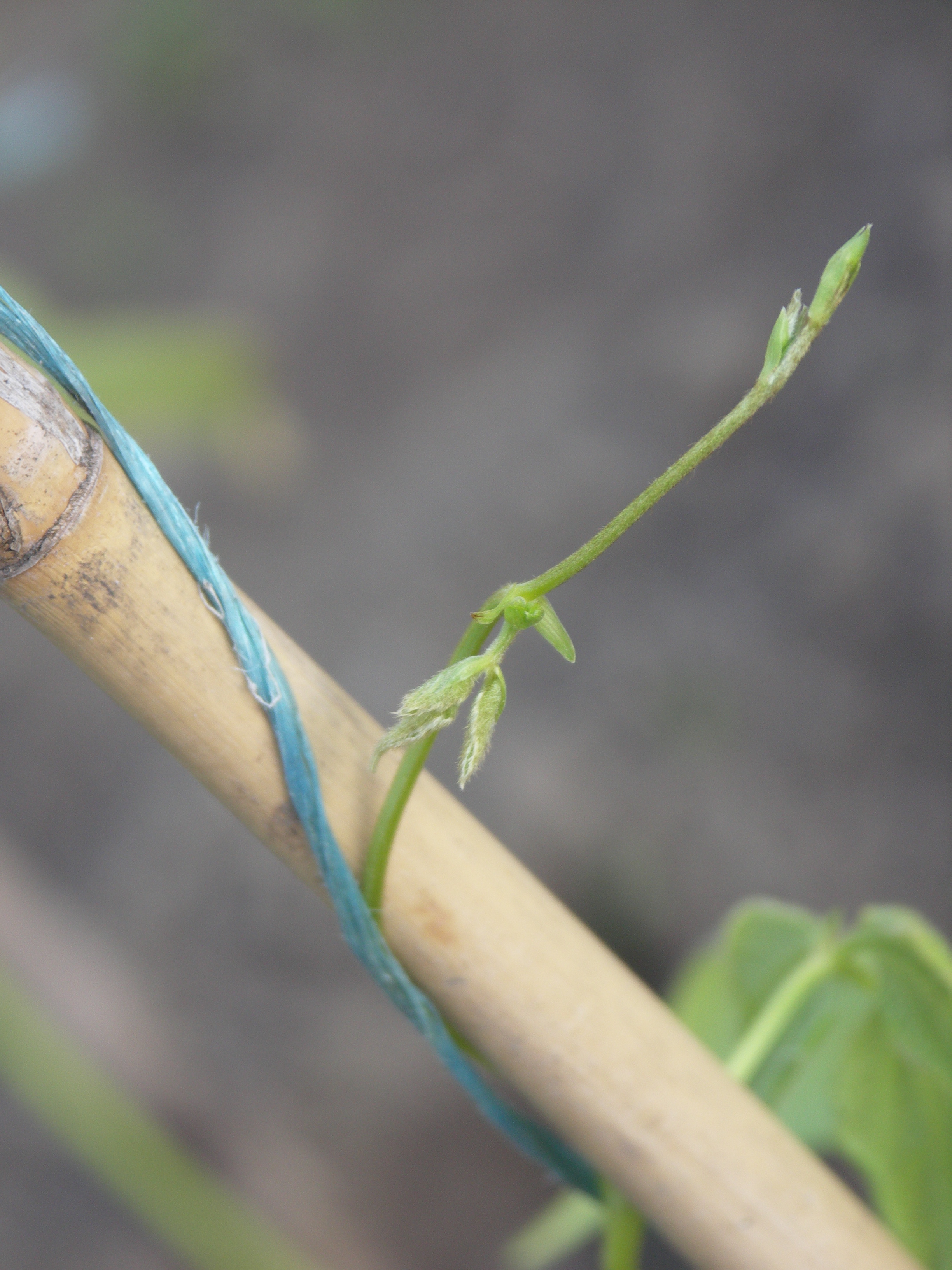
The beans are climbing, with a little help from blue string

Our good old traditional hoe is a fine and trusty looking tool.  A blade securely attached to a solid pole by means of two sturdy metal arms with a crescent top.  This is a hoe that has seen many a row of beans and borders and the pole is looking increasingly rotten while the blade is a dull rust colour.  I had a go with it, and had some success, but then discovered my dad’s new hoe which is a light sabre compared to the dull claymore that is the old one.  This one has a shining steel blade – or should I say blades, as it is secured only on side, while the other side can be used to deliver a lateral swipe.  This is both useful and intimidating, as I now have the opportunity to destroy my bean crop with forward, backward AND sideways swipes.

I used it around my runner beans and broad beans.  In recent years we have been picking veg while trying to dodge nettles and I do not want this to happen this year.  My main weapon in this battle is the Vorpal Blade that is the old man’s hoe.

And what joy it brings.  My borders and rows are looking dry and weed free with the soil nicely turned and friable, showing the plants at their best. That is something to bring a smile to one’s face.  Perhaps even a little chesty chortle of joy.